
Have you ever wondered what your daily life would look like if the power grid suddenly failed? In my novel, The Long Walk Home: When the Power Dies, I explore a world plunged into darkness. Recently, I was challenged to describe my own life without electricity—and surprisingly, I have some firsthand experience from my college days working at a living history interpretive backcountry camp at Philmont Scout Ranch.
A Summer Unplugged at French Henry
The camp, called French Henry, was about as off-the-grid as it gets. Our only electricity came from portable transceiver radios, which we turned on for just half an hour each evening, and battery-powered headlamps for mine tours. This was back when cell phones were a novelty— I only knew one person with one, my father’s business partner Bruce, and it was bolted into his car. A few of us (there were five staff total) might have had Walkmans, but that was the extent of our tech.
Vehicles were a rare sight: once to drop us off, twice for visitors, and once to pick us up at summer’s end. We had days off to dip back into “civilization,” but otherwise, it was an electricity-free adventure.
Living by Nature’s Rhythm
We synced our lives to the sun’s cycle, relying on wind-up alarm clocks and pocket watches. Mornings started early—I was usually the second up after Scott, who’d jog to Baldy Town or Copper Park above us. I’d chop and split wood, then fire up the woodstove. Our camp director, whom we called Friar, would brew “cowboy” coffee once the stove heated up.
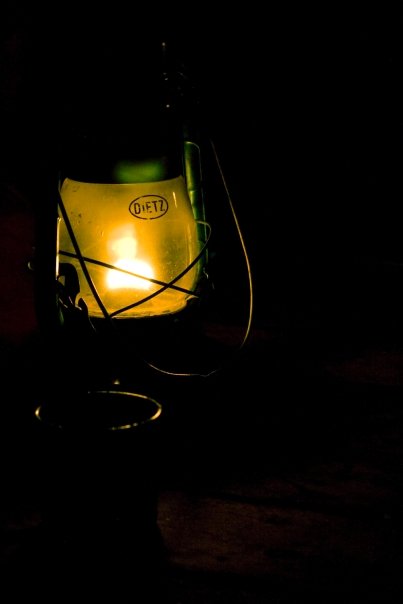
Days were filled with delivering programs like mine tours and blacksmithing demos. Evenings brought woodstove-cooked meals, followed by relaxing around kerosene lanterns—two table lamps and several Dietz #76 blue oil burners. We’d chat, read, write letters, or play games in that warm glow.
Once a week, two of us hiked to Baldy Town with our burros, Fred and Barney (both jennies, despite the names), to fetch supplies. No refrigeration meant sinking a five-gallon (about 20-liter) stew pot into a stream diversion pool to keep perishables cool. It worked well at 9,600 feet (2,928 meters) elevation, with the stream fed by icy snowmelt—until a bear raided it a couple of times. We’d improvise for the week, but it was no big hardship. That same stream was our unfiltered water source; we never purified it all summer.
It felt like a charmed, idyllic existence, even without power.
How Would It Play Out Today?
Fast-forward to now: I still live in the mountains at 8,800 feet (2,682 meters), just 13 miles (21 kilometers) from French Henry. My home has a fireplace, and we’ve endured multi-day outages in our rural town. Even with a fire going, the house chills quickly in winter, and we burn through wood fast. Without a woodstove, cooking gets tricky. Lighting relies on battery lamps during outages, but long-term? We’d need kerosene lamps or candles—dim and inefficient. Catalogs like Lehman’s sell brighter Aladdin lamps, and Coleman-style pressurized white gas lamps also exist… but what happens when fuel runs out?
Water’s nearby—a small river about 100 yards (meters) away—and I have five-gallon (20-liter) containers for hauling. Food is the real puzzle. We’re far from major towns; the nearest farm is a 23-minute drive or seven-hour walk. I’ve biked there in about 1.5 hours one way.
I own hunting and fishing gear, so protein from wildlife could work, if animals cooperate. The short growing season limits veggies, but locals manage with supplemental gardens and cold frames—we’d adapt by the first full season. Staples like milk, eggs, and flour? Big challenges. A root cellar under the house could store food safely from animals.
Our area has horse owners; I imagine horse-drawn wagons resuming deliveries eventually. I also have hand tools—saws, brace drills, planes—for repairs and building.
The Bigger Picture: Survival and Society
All this raises a tough question: How long before my wife and I relocate to somewhere more sustainable, with easier access to essentials? Writing would persist—humans always tell stories—but sharing it? Forget easy dissemination; we’d await printing presses’ revival.
I own helpful books like Pocket Ref by Thomas J. Glover and Back to Basics edited by Norman Mack for Reader’s Digest. What others would you recommend for off-grid living?
In writing The Long Walk Home, I pondered these shifts—and they’re massive. Could I hack it? Yes, but it’d be miserable, scraping by with my existing skills. How about you? How do you think your community would fare?
By the way, this blog’s photo is by a great friend, Justin Kernes. You can see more of his amazing work at https://www.justinkernes.com/
 Michael H. Ritterhouse
Leave a comment